Certified CSM Professional
Detailed Certification Program Overview
The CCSMP program is a rigorous, framework-based certification path designed to transition CS practitioners into high-value business consultants. It provides a standardized, five-level roadmap for mastering the “Human Layer” of customer engagement to drive measurable business outcomes.
Contents
Certified CSM Professional Program Overview
Practical CSM Framework
Certified CSM Professional Level 1
Certified CSM Professional Level 2
- Level 2 Overview
- Module 3: Practical CSM Framework Phase 1: Preparation
- Module 4: Practical CSM Framework Phase 2: Commitment
- Module 5: Practical CSM Framework Phase 3: Onboarding
Certified CSM Professional Level 3
- Level 3 Overview
- Module 6: Practical CSM Framework Phase 4: Adoption Planning
- Module 7: Practical CSM Framework Phase 5: Adoption Implementation
- Module 8: Practical CSM Framework Phase 6: Value Realization
- Module 9: Practical CSM Framework Phase 7: Engagement Evaluation
- Module 10: Putting It All Together
Certified CSM Professional Level 4 – Exams
Level 5 – Continuing Professional Development & Recertification
- Level 5 Overview
- Component 1: CPD Paths
- Component 2: Content Library
- Component 3: Live Events Calendar
- Component 4: Suggest a New CPD Training Topic
- Component 5: CPD Self Certification
- Component 6: Reporting & Recertification
Certified CSM Professional Program Overview
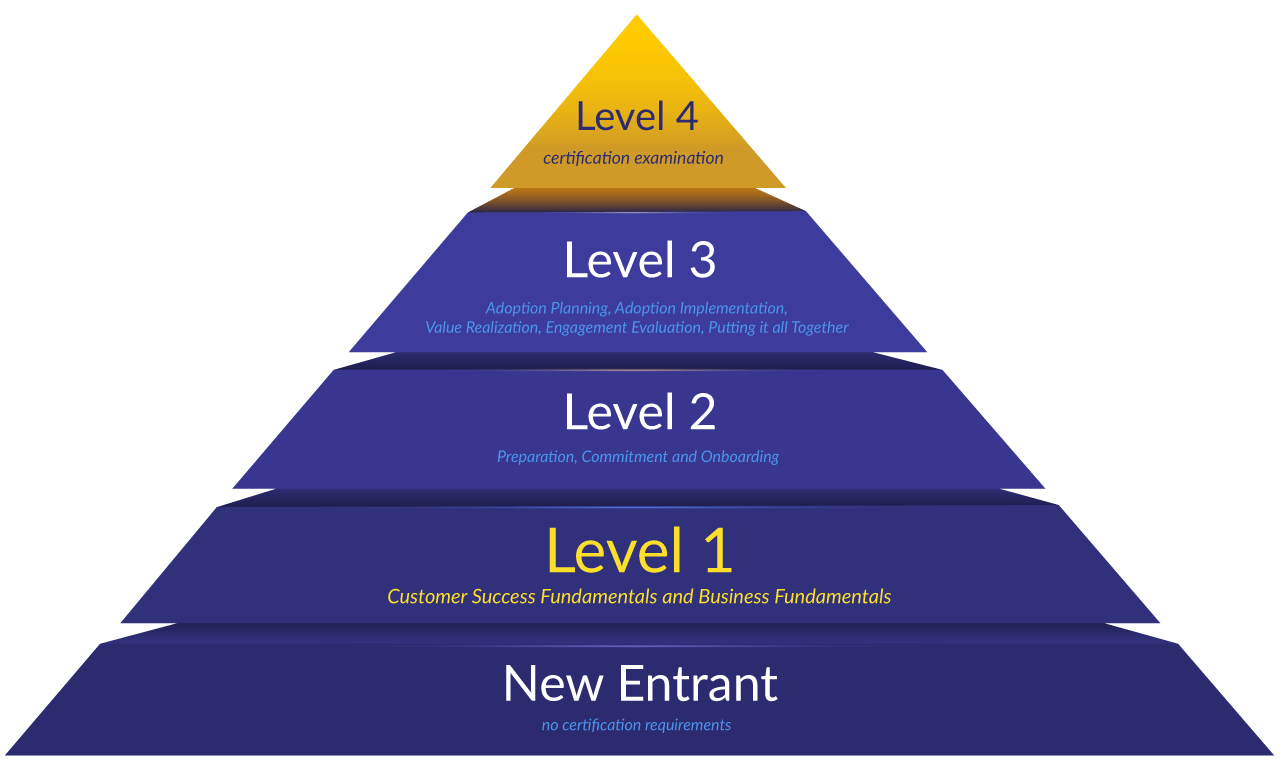 The CCSMP program is a comprehensive, expert-led certification path built around the industry-standard Practical CSM Framework — created by Rick Adams, the same expert who designed Cisco’s internal Customer Success certification program. The framework is now globally recognized and published by Taylor & Francis.
Structured into five progressive levels, CCSMP guides learners from foundational Customer Success knowledge to advanced strategy, leadership, and continued professional growth. The curriculum is:
- Grounded in Bloom’s Taxonomy for effective adult learning
- Aligned with ISO/IEC 17024 certification principles
- Governed by a Certification Oversight Committee made up of senior CS leaders
The program combines structured content with practical tools, real-world applications, and automatic progress tracking. Learners move through levels covering foundational concepts, the full Practical CSM Framework, certification exams, and CPD — ensuring they gain both competence and confidence at every stage of their CS career.
Practical CSM Framework
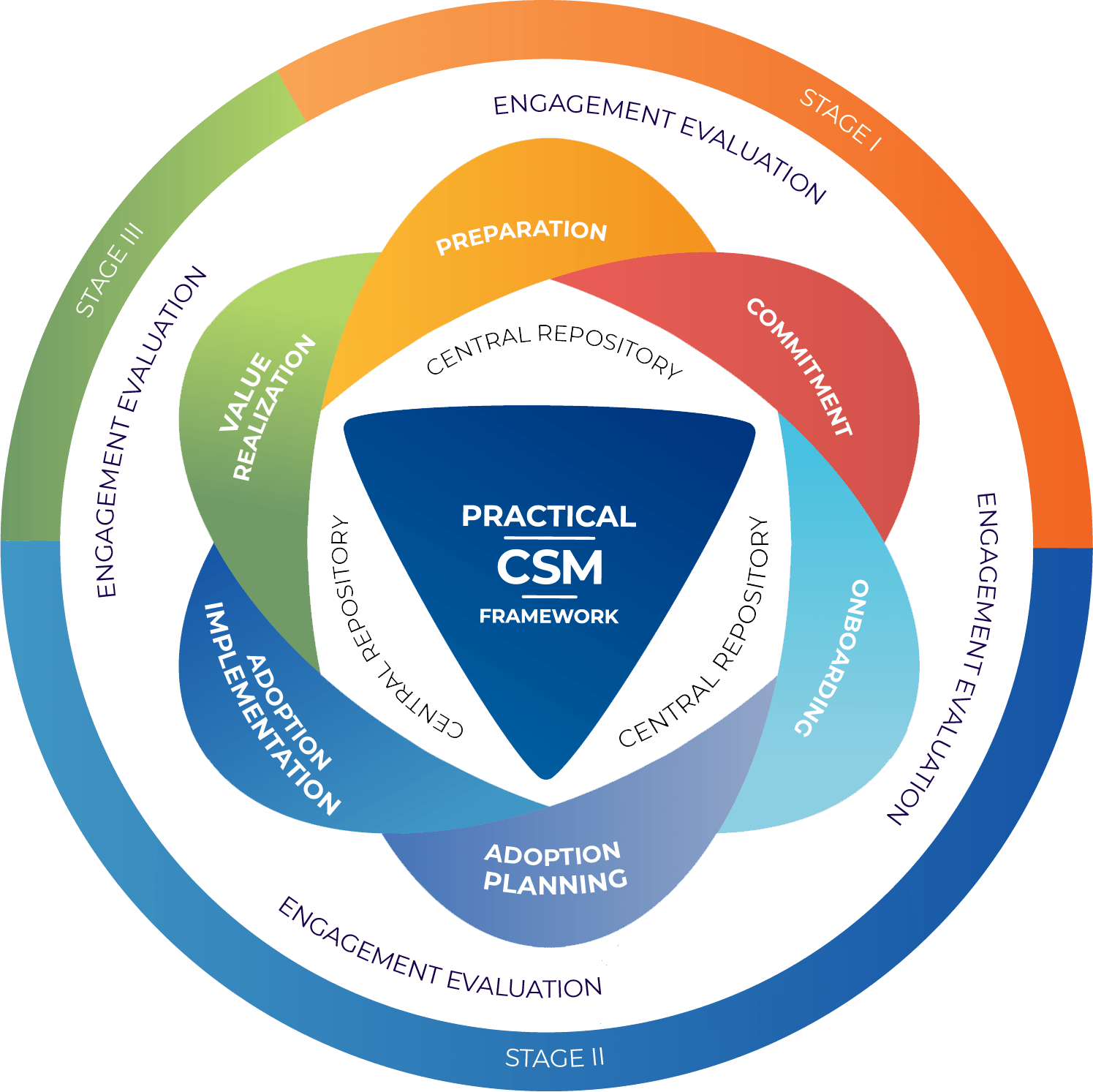
The Practical CSM Framework is not just a methodology; it is a globally recognized standard for delivering measurable customer value. Designed by Rick Adams – the architect behind Cisco’s internal CS certification – the framework provides a seven-phase roadmap that aligns supplier activities with the customer’s internal business drivers.
For the educated researcher, the framework acts as a risk-mitigation tool. It moves beyond reactive “firefighting” to a proactive, phase-gated approach that ensures every action taken by the CSM is anchored in a specific, desired customer outcome.
Certified CSM Professional Level 1
Level 1 Overview
CCSMP Level 1: Foundations of Business-Centric Success
Outcome: Transitioning from a “product expert” to a “business partner.” Level 1 dismantles the “customer support” mindset and replaces it with the 14 Tenets of Customer Success. Candidates move beyond knowing what the product does to understanding why the customer’s business exists and how it creates value for its own stakeholders.
- Core Skills: Mastery of the CSM role’s guiding principles and the ability to calculate Customer Lifetime Value (CLV) as a strategic metric
- Business Literacy: Understanding organizational structures, value propositions, and the Business Motivation Model (BMM) to align CS initiatives with corporate strategy.
- Framework Relation: This level provides the “Central Repository” of knowledge required to enter Phase 1 (Preparation) with professional credibility
- Shareable Badges: 2
- Available in: CCSMP Basic, Scholar & Full memberships
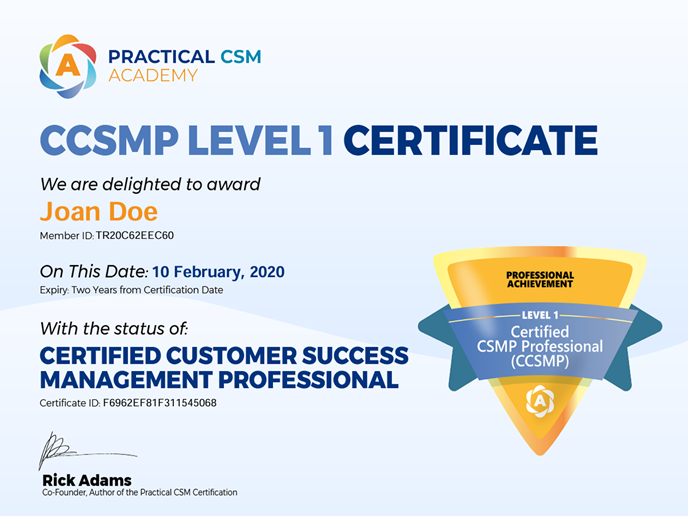
Level 1 Sample Certificate
Level 1 Sample Evidence Page
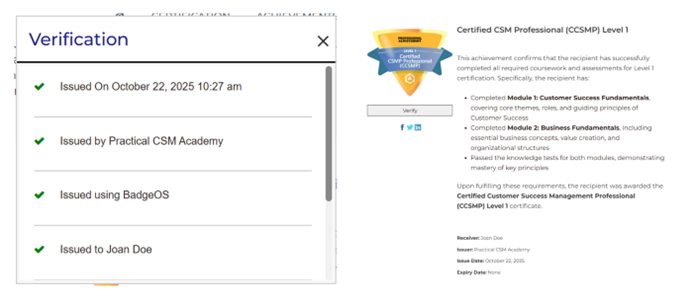
https://academy.practicalcsm.com/evidence-page/?bg=78508&eid=23479&uid=10
Module 1: Customer Success Fundamentals
 The Customer Success Fundamentals module provides a basic overview of the core themes and concepts of Customer Success. To explore this topic, we will be answering the following questions: What is Customer Success and why is it important? Who is Customer Success important to? What is Customer Success Management? What types of situations does Customer Success Management apply to? and… How can Customer Success Management help to increase a company’s sales revenues and profitability? We will then discuss 14 tenets (or guiding principles) of customer success that will outline the role of the CSM (or customer success manager) in ensuring that customer success occurs and that its benefits are realized by both the CSM’s own company and its customers.
Module 1 Content
- Lessons: 11
- Workbooks: 2
- Scenario-based Exercises: 1
- Tests: 15 questions, multiple attempts
Module 1 Lessons
1.1 What is Customer Success?
Fundamental information about what is meant by the terms “customer success” and “customer success management”, including what they are, what they do, and what value they provide.
- What is Customer Success and Why is it Important?
- What is Customer Success Management?
- Why Invest in Customer Success Management?
1.2 How Does Customer Success Work?
A basic explanation of how customer success works, and the basic concepts behind customer success management.
1.3 Customer Renewals and Retention/Churn
Definitions for the terms “renewals”, “retention” and “churn” and a basic explanation of the CSM’s role in maximizing renewals through increased retention and decreased churn.
1.4 Customer Success in Different Business Types
A basic discussion on how the principles and concepts of customer success management apply not just to software-as-a-service companies or even to other companies that provide services on a contractor, but to all companies regardless of how their products and/or services are sold.
1.5 Land and Expand Sales Motions
Definitions for the terms “land” and “expand” and a basic explanation of the CSM’s role in maximizing renewals through increased expand opportunities.
1.6 Customer Advocacy and Lifetime Value
The concept of customer lifetime value (or CLV) and its importance to a company’s ongoing success is discussed and explained, together with an example of how CLV might be calculated. In addition, the concept of customer advocacy and the role of the CSM in securing increased advocacy is described.
- Customer Lifetime Value (CLV)
- Customer Advocacy
1.7 Tenets of Customer Success Part 1 of 5
“Tenets” (or guiding principles) One to Three of customer success are described and explained. These are “The CSM Exists to Create Value for Their Own Company”, “The CSM’s primary task is to help customers attain measurable value from using their company’s products and services” and “The CSM is a subject matter expert in how to adopt, use and realize value from their company’s products and services”.
1.8 Tenets of Customer Success Part 2 of 5
“Tenets” (or guiding principles) Four to Six of customer success are described and explained. These are “The CSM understands the customer’s business”, “The CSM is a researcher and an analyst” and “The CSM is a consultant and an adviser”.
- The CSM understands the customer’s business
- The CSM is a researcher and an analyst
- The CSM is a consultant and an adviser
1.9 Tenets of Customer Success Part 3 of 5
“Tenets” (or guiding principles) Seven to Nine of customer success are described and explained. These are “The CSM is an educator”, “The CSM is a communicator” and “The CSM is an influencer and an enabler”.
- The CSM is an educator
- The CSM is a communicator
- The CSM is an influencer and an enabler
1.10 Tenets of Customer Success Part 4 of 5
“Tenets” (or guiding principles) Ten to Twelve of customer success are described and explained. These are “The CSM is a planner and a project manager”, “The CSM is a problem solver” and “The CSM is a pragmatist”.
- The CSM is a planner and a project manager
- The CSM is a problem solver
- The CSM is a pragmatist
1.11 Tenets of Customer Success Part 5 of 5
“Tenets” (or guiding principles) Thirteen to Fourteen of customer success are described and explained. These are “The CSM proactively seeks further sales opportunities” and “The CSM should do as little as possible – ideally nothing at all”. Advice is also provided for CSMs to reflect upon their own knowledge, skills, and experience.
- The CSM proactively seeks further sales opportunities
- The CSM should do as little as possible – ideally nothing at all
- Reflecting on your own knowledge, skills, and experience
Module 2: Business Fundamentals
 It is critical for customer success managers to have a sufficiently detailed level of business awareness, yet relatively few CSMs ever receive any training or even any formal information about how businesses work and additionally, relatively few CSMs come to the role already with this knowledge. In this module we will be examining the connection between customer success managers and business awareness, the reasons why businesses exist in the first place, how businesses create value for their owners and who else businesses create value for, and how expenditure and profits are calculated. We then will look at how businesses work in terms of how they are organized, what they do, what resources they need and what relationships they have with other entities. After this we will discuss the principles of business management, including the things that influence change within a business and how business strategy is formulated.
Module 2 Content
- Lessons: 11
- Workbooks: 2
- Scenario-based Exercises: 1
- Tests: 15 questions, multiple attempts
Module 2 Lessons
2.1 CSMs and Business Awareness
An explanation for what is meant by the term “business fundamentals” and why an understanding of these fundamentals is essential to many (if not all) customer success managers.
2.2 Why Businesses Exist
An overview of the reason behind why businesses exist and how they fulfill this purpose.
2.3 How Businesses Create Value for Owners
Provides an explanation of how value is generated for the business’s owners.
2.4 Who Else Businesses Create Value For
Lists who else (besides owners) businesses generate value for, and why this is important.
2.5 How Expenditure & Profits are Calculated
A brief overview of how businesses calculate both their expenditure and their profits in order to generate an “annual return” statement.
2.6 Customer Segments & Value Propositions
An overview of what customer segmentation and value propositions are, and a discussion on how they relate to each other and why they are important for businesses to understand and to get right.
2.7 How Businesses Work: Organization
A discussion on how businesses are organized and managed, together with a review of typical company org chart.
2.8 How Businesses Work: Capabilities
An explanation for what is meant by the term “business capability” and a discussion about how the concept of business capabilities can be used to define and understand everything that a business does.
2.9 Principles of Business Management: Drivers for Change
A discussion on why businesses are constantly needing to change, with examples to illustrate how this works in real life.
2.10 How Businesses Work: Strategy Formulation
A discussion about vision and strategy formulation and how it occurs in a modern business.
2.11 The Business Motivation Model (BMM)
An overview of the BMM (Business Motivation Model), including discussion on each component of the BMM and how they come together to create meaningful change within a business.
Certified CSM Professional Level 2
Level 2 Overview
CCSMP Level 2: Mastering the Engagement On-Ramp (Phases 1-3)
Outcome: Establishing alignment and accelerating Time-to-Value (TtV).
Level 2 focuses on the critical “First 90 Days” of an engagement. It provides the tactical tools to move from initial research to a fully committed customer stakeholder group.
- Phase 1 (Preparation): Developing a Customer Research Checklist to validate customer initiatives before the first meeting
- Phase 2 (Commitment): Moving from “casual agreement” to a formal Customer Success Plan using RACI matrices and Stakeholder Management Plans
- Phase 3 (Onboarding): Implementing service models (Generic vs. Customized) that minimize friction and prioritize the shortest path to value
- Shareable Badges: 3
- Available in: CCSMP Scholar & Full Memberships
Level 2 Sample Certificate & Evidence Page
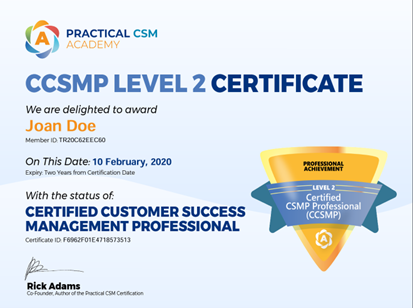
Sample Evidence Page:
https://academy.practicalcsm.com/evidence-page/?bg=78527&eid=23478&uid=10
Module 3: Practical CSM Framework Phase 1: Preparation
 The secret to most professions lies in preparatory work, and this is no less true for Customer Success Management than for any other type of work. The starting point for Customer Success Managers, when faced with any new customer engagement, is firstly to prepare themselves by performing research and analysis to understand the customer, its challenges and initiatives and the details about the solution it has purchased. After this, the CSM needs to prepare the customer for the upcoming onboarding, adoption, and value realization work that lies ahead of them if they are going to generate successful outcomes from the purchase and utilization of the CSM’s company’s solutions. This module takes CSMs through the processes and steps needed to ensure that both they themselves and their customer’s stakeholders are fully prepared and ready to proceed with making the customer’s initiative successful.
Module 3 Content
- Lessons: 12
- Workbooks: 2
- Scenario-based Exercises: 1
- Tests: 15 questions, multiple attempts
- Downloadable Tools:
- 1 Customer Research Checklist (Excel)
- 2 Customer Engagement Strategy (Excel)
- PCSMF Phase 1 Engagement Roadmap (PowerPoint)
Module 3 Lessons
3.1 Providing a Joined Up Customer Experience
A discussion on the importance of ensuring customers receive continuity of service between the different people, functions and departments that interact with them as they undergo their customer journey, in order to ensure the best possible level of CX (customer experience).
3.2 Sources for Researching Customer Information
An overview of the different sources of customer-related information that are generally available for customer success managers to use when performing research about a customer.
3.3 Selecting & Validating Customer Information
The difference between validated and unvalidated information and how to determine what data or information requires validation.
3.4 Information to Research Part One
First of two parts of a discussion about what types of information or data a customer success manager should consider research and documenting when faced with a new customer engagement. This part covers information relating to customer, solution, outcomes and the customer’s initiative.
- Information to Research: Customer
- Information to Research: Solution
- Information to Research: Outcomes
- Information to Research: Customer Initiative
3.5 Information to Research Part Two
Second of two parts of a discussion about what types of information or data a customer success manager should consider research and documenting when faced with a new customer engagement. This part covers information relating to stakeholders and capabilities.
- Information to Research: Stakeholders
- Information to Research: Capabilities
3.6 The Customer Research Checklist Tool Part One
First of four parts of a discussion about how to use the Customer Research Checklist Tool as a template for performing preparatory research for a new customer engagement. This part provides an overview and discusses the Customer tab.
- The Customer Research Checklist Tool: Overview
- The Customer Research Checklist Tool: Customer Tab
3.7 The Customer Research Checklist Tool Part Two
Second of four parts of a discussion about how to use the Customer Research Checklist Tool as a template for performing preparatory research for a new customer engagement. This part discusses the Solution tab.
3.8 The Customer Research Checklist Tool Part Three
Third of four parts of a discussion about how to use the Customer Research Checklist Tool as a template for performing preparatory research for new customer engagement. This part discusses the Initiative and Stakeholders tabs.
- The Customer Research Checklist Tool: Initiative Tab
- The Customer Research Checklist Tool: Stakeholders Tab
3.9 The Customer Research Checklist Tool Part Four
Fourth of four parts of a discussion about how to use the Customer Research Checklist Tool as a template for performing preparatory research for a new customer engagement. This part discusses the Progress tab and provides advice on utilization.
- The Customer Research Checklist Tool: Progress Tab
- The Customer Research Checklist Tool: Utilization
3.10 Engagement Planning & Engagement Strategy Tool
A discussion on the importance of and recommended best practice for engagement planning prior to meeting the customer’s stakeholders, and an overview of the Engagement Strategy Tool.
3.11 Engagement Strategy Part One
Part one of two parts of a discussion about how to create an engagement strategy. This part discusses priority, complexity, and maturity.
3.12 Engagement Strategy Part Two
Part two of two parts of a discussion about how to create an engagement strategy. This part discusses outcomes, milestones, measurements, activities, and roadmaps.
- Engagement Strategy: Outcomes, Milestones & Measurements
- Engagement Strategy: Activities & Roadmap
Module 4: Practical CSM Framework Phase 2: Commitment
 It is very hard to achieve high-quality results when the CSM is not fully aligned to the customer’s needs and/or when the customer and its stakeholders are not fully committed to an agreed course of action that involves the CSM to whatever greater or lesser extent is necessary. It is therefore essential that CSMs take the time to ensure that their work with the customer and its stakeholders is effective. Doing this involves establishing good working relationships with those stakeholders, and holding high-quality meetings, where the right questions get asked. It also involves analyzing and identifying who will be involved in the engagement and how they should be managed. Finally, it involves the joint creation of a Customer Success Plan that everyone has agreed with and is willing to adhere to.
Module 4 Content
- Lessons: 9
- Workbooks: 2
- Scenario-based Exercises: 1
- Tests: 15 questions, multiple attempts
- Downloadable Tools:
- 1 RACI Matrix (Excel)
- 2 Stakeholder Management Template (PowerPoint)
- 3 Stakeholder Management Plan (Excel)
- 4 Customer Engagement Proposal (Word)
Module 4 Lessons
4.1 Working With the Customer: Key Concepts
An overview of the purpose and process of working with the customer, together with a brief discussion of the fundamental knowledge and skills necessary to engage successfully with customer stakeholders.
4.2 Working With the Customer: Credibility & Rapport
A discussion about how to create, develop and manage relationships with customer stakeholders, with a particular focus on the importance of both credibility and rapport.
4.3 The Customer Success Proposal
An explanation of what a customer success proposal is, together with a discussion about what to put into it and how to use it.
4.4 Meetings Best Practice
A detailed, step by step guide to creating and leading productive and efficient meetings.
4.5 Consultative Questioning
A discussion on why consultative questioning skills are important to CSMs, together with an overview of consultative questioning best practice.
4.6 Using the RACI Matrix
An overview of what the RACI Matrix is and practical advice on how to use it to determine stakeholder roles within any customer engagement.
4.7 Using the Stakeholder Management Matrix
An overview of what the Stakeholder Management Matrix is and practical advice on how to use it to create a stakeholder management matrix for a customer engagement.
4.8 Creating a Stakeholder Management Plan
An overview of what the Stakeholder Management Plan is and practical advice on how to use it to create a stakeholder management plan for a customer engagement.
4.9 Completing the Customer Success Proposal
Practical advice on how to create a customer success proposal for customer engagement and how to present it to and use it with customer stakeholders.
Module 5: Practical CSM Framework Phase 3: Onboarding
 A core aspect of any Customer Success Manager’s role is to get customers up and running and utilizing the solutions they have purchased from the CSM’s company as swiftly and as painlessly as possible. Doing so reduces any possible frustration felt on the part of customers’ stakeholders caused by unnecessary delays or additional and unexpected workloads and brings forward the “Time to Value” (or TtV) experienced by the customer so that overall, the customer gains the best possible results from their purchase in the shortest possible time. This course describes the steps that CSMs should take during the initial Onboarding process, which is all about getting the customer acquainted with what they have purchased and ensuring they understand what needs to be done to get their users up and running and generating value with the products and/or services they have purchased.
Module 5 Content
- Lessons: 11
- Workbooks: 2
- Scenario-based Exercises: 1
- Tests: 15 questions, multiple attempts
- Downloadable Tools:
- 1 Onboarding Scoring Matrix (Excel)
- 2 Onboarding Requirements Questionnaire (Excel)
- 3 Onboarding Project Plan (Excel)
- 4 Onboarding Activity Checklist (Excel)
Module 5 Lessons
5.1 What is “Onboarding”?
An explanation for what is meant by the term “onboarding” and a brief overview of what it includes.
5.2 Why is Onboarding Important?
A discussion on why onboarding is important to get right from the perspectives of both customers and suppliers.
5.3 Onboarding Vs Adoption Vs Value Realization
An overview of the differences between onboarding, adoption, and value realization phases within the Practical CSM Framework.
5.4 Selecting an Onboarding Service Model Part 1
Part 1 of 2. A discussion about how to select between generic or customized onboarding as the model to offer a customer, plus a more detailed overview of the generic onboarding service model.
- Selecting an Onboarding Service Model
- Using a Generic Onboarding Service Model
5.5 Selecting an Onboarding Service Model Part 2
Part 2 of 2. An overview of the customized onboarding service model Using a Customized Onboarding Service Model.
5.6 Onboarding Services at Your Company
A discussion on how to determine what type (or types) of onboarding service might be the right service to offer your own customers.
5.7 Selecting the Onboarding Model
A discussion on the four aspects of a customer initiative that influence the selection of an onboarding model, together with an overview of how to use the Onboarding Scoring Matrix, and advice on how to discuss onboarding with customer stakeholders.
- Four Influencers of Onboarding
- The Customer Onboarding Scoring Matrix
- Onboarding Discussions with the Customer
5.8 Customized Onboarding and Full Adoption Services
An explanation of the differences and similarities between customized onboarding and full adoption services and a review of the three choices for onboarding: generic, customized or fully bespoke.
- Customized Onboarding and Full Adoption Services
- Three Choices for Onboarding: Generic, Customized or Fully Bespoke
5.9 Information for Generic Onboarding
A detailed overview of the information the CSM and customer need to research in order to prepare for generic onboarding.
5.10 Information for Customized Onboarding
A detailed overview of the information the CSM and customer need to research in order to prepare for customized onboarding.
5.11 Managing the Onboarding Process
A discussion on best practices for managing the onboarding process, followed by some advice on how to develop the right onboarding services for your company.
- Managing the Onboarding Process
- Developing the Right Onboarding Services
Certified CSM Professional Level 3
Level 3 Overview
CCSMP Level 3: Driving Adoption & Value Realization (Phases 4-7)
Outcome: Operationalizing change and proving ROI.
Level 3 is where strategy meets execution. It addresses the “Human Layer” of software implementation—change management—and the rigorous evaluation of whether the promised value was actually delivered.
- Phase 4 & 5 (Adoption): Distinguishing between adoption planning and implementation by analyzing user Knowledge, Skills, and Attitude (KSA)
- Phase 6 (Value Realization): Moving beyond usage metrics to document and present tangible business outcomes to the customer’s executive team
- Phase 7 (Engagement Evaluation): A reflective loop to analyze engagement efficiency and determine the next logical “Land and Expand” motion
- Shareable Badges: 5
- Available in: CCSMP Scholar & Full Memberships
Level 3 Sample Certificate & Evidence Page
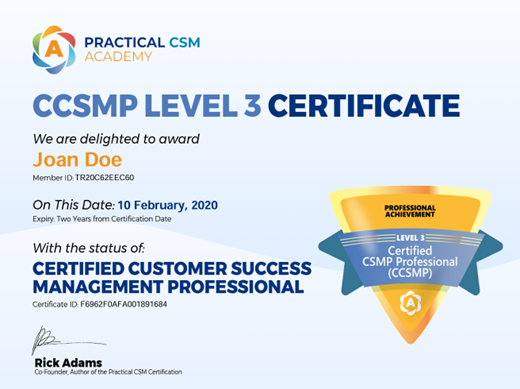
Sample Evidence Page:
https://academy.practicalcsm.com/evidence-page/?bg=78530&eid=23477&uid=10
Module 6: Practical CSM Framework Phase 4: Adoption Planning
 Adoption is such an important part of the job of any Customer Success Manager that we have divided it up into two separate modules – this module that you are currently studying which is called Adoption Planning and the next module which is called Adoption Implementation. Adoption planning and adoption implementation require two quite different sets of skills and process steps to complete. In adoption planning, we will take you through what Adoption is and how it works, and we will look at Adoption from the perspective of end-user change management. We will review how to understand the KSA (or Knowledge, Skills, and Attitude) needs of each impacted user, and the differences and similarities between directly and indirectly impacted users. We will review the adoption requirements workshopping process and how to gain consensus agreement from all necessary stakeholders that user adoption requirements have been correctly researched and documented. Finally, we will turn to what tools and techniques are available to help the CSM produce a meaningful adoption plan.
Module 6 Content
- Lessons: 11
- Workbooks: 2
- Scenario-based Exercises: 1
- Tests: 15 questions, multiple attempts
- Downloadable Tools:
- 1 Adoption Research Checklist (Excel)
- 2 Adoption Plan (Excel)
Module 6 Lessons
6.1 Adoption Fundamentals
A discussion about how get adoption requirements for an engagement agreed by all relevant stakeholders.
6.2 Adoption and Change Management
An explanation as to the role of the CSM within the adoption planning process, with specific reference to the relationship between CSM and customer stakeholders.
6.3 Knowledge Skills & Attitude (KSA) Concepts
An overview of the adoption planning process and associated best practices.
6.4 Directly & Indirectly Impacted Users
Part 1 of 3 of a discussion about adoption planning tools. This part provides an overview of the tools and then focuses on general adoption requirements and on capabilities and processes.
- Adoption Planning Tools: Existing Tools
- Adoption Planning Tools: General Adoption Requirements
- Adoption Planning Tools: Capabilities & Processes
6.5 Research Techniques: The Workshop
Part 2 of 3 of a discussion about adoption planning tools. This part focuses on impacted groups, on adoption activities, and on practical considerations
- Adoption Planning Tools: Impacted Groups
- Adoption Planning Tools: Adoption Activities
- Adoption Planning Tools: Practical Considerations
6.6 Getting the Adoption Requirements Agreed
A discussion about how to get adoption requirements for an engagement agreed by all relevant stakeholders.
6.7 The Role of the CSM in Adoption Planning
An explanation as to the role of the CSM within the adoption planning process, with specific reference to the relationship between CSM and customer stakeholders.
6.8 The Adoption Planning Process
An overview of the adoption planning process and associated best practices.
6.9 Adoption Planning Tools Part One
Part 1 of 3 of a discussion about adoption planning tools. This part provides an overview of the tools and then focuses on general adoption requirements and on capabilities and processes.
- Adoption Planning Tools: Existing Tools
- Adoption Planning Tools: General Adoption Requirements
- Adoption Planning Tools: Capabilities & Processes
6.10 Adoption Planning Tools Part Two
Part 2 of 3 of a discussion about adoption planning tools. This part focuses on impacted groups, on adoption activities and on practical considerations.
- Adoption Planning Tools: Impacted Groups
- Adoption Planning Tools: Adoption Activities
- Adoption Planning Tools: Practical Considerations
6.11 Adoption Planning Tools Part Three
Part 3 of 3 of a discussion about adoption planning tools. This part focuses on adoption barriers and on adoption risks.
- Adoption Planning Tools: Adoption Barriers
- Adoption Planning Tools: Adoption Risks
Module 7: Practical CSM Framework Phase 5: Adoption Implementation
 As you already know from the previous module, Adoption is such an important part of the job of any Customer Success Manager that we have divided it up into two separate modules – this module that you are currently studying which is called Adoption Implementation and the previous module which is called Adoption Planning, and adoption planning and adoption implementation require two quite different sets of skills and process steps to complete. In adoption implementation, we will focus on the practical steps that CSMs can take to help their customers implement their adoption plan to get their users trained and upskilled in the processes they need to complete to use the new products and/or services that their company has purchased. We will look at how to use project management concepts and best practices to help manage the adoption process, how to prepare for project kick-off and how to manage people and conflict. We will review tools, for task management, how to measure and report on adoption activity and how to handle problems if they occur.
Module 7 Content
- Lessons: 11
- Workbooks: 2
- Scenario-based Exercises: 1
- Tests: 15 questions, multiple attempts
- Downloadable Tools:
- 1 Adoption Readiness Checklist (Excel)
Module 7 Lessons
7.1 Adoption Implementation Roles
A discussion on the different roles played by the CSM and customer stakeholders during the adoption implementation process.
7.2 Project Management Principles & Best Practices
An overview of how project management principles and techniques can be utilized by CSMs during the adoption implementation process to maximize efficiency, productivity and quality and reduce time to value.
7.3 Preparing for Project Kick-Off
A discussion about the steps to take when preparing for adoption kick-off, together with an overview of the adoption kick-off check list.
7.4 Managing People
A discussion about the import role that both stakeholders and end-users play in the successful implementation of an adoption project, and an overview of best practice advice managing them.
7.5 Managing End User Conflict
A discussion about how conflict can arise during adoption implementation and an overview of a best practice process for managing conflict if it does arise.
7.6 Adoption Task Management Tools Part 1
Part one of two, dealing with adoption of task management. This part provides an overview of adoption task management and explains how to use WBS (work breakdown structure) to determine what tasks need to be completed and in what order to complete them.
7.7 Adoption Task Management Tools Part 2
Part one of two, dealing with adoption task management. This part explains how CPM (critical path method) can be applied to an adoption implementation to determine the critical path through the implementation project in order to calculate the total duration. It also discusses how to combine WBS with CPM to enable high-quality project management of an adoption implementation project.
- The Critical Path Method (CPM)
- Adoption Task Management Using WBS and CPM
7.8 Adoption Activity Measurement
A discussion about the importance of measuring adoption activities to determine results, followed by a breakdown of core measurement components including targets, baselines and milestones.
- Adoption Activity Measurement and Reporting
- Targets, Baselines, and Milestones
7.9 Adoption Activity Reporting
A discussion about the need for reporting both during and following adoption implementation, including an overview of how to format information in order to make it easily understandable.
7.10 Best Practices for Problem Handling
An overview of the best practice techniques for handling problems, including detailed step-by-step processes for root cause analysis and for problem management.
7.11 Adoption Project Completion
An explanation as to what needs to be done at the end of the adoption implementation process in order to ensure customer stakeholders are satisfied with the results and that the customer can now commence value realization activities. Includes discussion on gaining sign off from the customer.
- Adoption Project Completion: Sign Off
- Adoption Project Completion: Readiness for Value Realization
Module 8: Practical CSM Framework Phase 6: Value Realization
 A critical aspect of any Customer Success Manager’s role is to help customers to generate measurable value from the solutions they have purchased from the CSM’s company. It is only by realizing value from a solution that a customer will want to renew or increase their existing service contracts and/or make additional product or service purchases. From the CSM’s company’s perspective, helping customers to understand the value they are getting and therefore continuing to purchase more of its solutions is precisely what Customer Success Management is all about. From the customers’ perspectives, the value realization stage is also critical, since it is during this stage that they start to realize a return from their investment in CSM’s company’s solutions. This module explains how CSMs can help customers both to maximize the actual value they attain from their solutions and to measure and report on that value.
Module 8 Content
- Lessons: 22
- Workbooks: 4
- Scenario-based Exercises: 1
- Tests: 15 questions, multiple attempts
- Downloadable Tools:
- 1 Value Realization Activity Checklist (Excel)
- 2 Value Realization Challenges and Changes (Excel)
Module 8 Lessons
8.1 Promised and Anticipated Value
An overview of what happens during Practical CSM Framework Phase Six: Value Realization and why it is essential for CSMs to understand both what value has been promised to the customer and what additional value the customer desires to attain.
8.2 Determining the Value Generated
A discussion about how value can be measured, including an explanation of the difference between direct and indirect value.
- Determining the Value Generated
- Direct Value (Direct Benefits)
8.3 Value is Not Always the Same
An explanation as to why value changes depending upon the situation, including between different solutions, different customers and different stakeholders.
8.4 Consultative Questioning
A refresher on the importance of consultative questioning skills, and a description of how they can be used to uncover additional areas for value realization.
8.5 Selecting Key Performance Indicators (KPIs)
An explanation of the concept of KPIs (key performance indicators) and a discussion about how to select meaningful and relevant KPIs for calculating customer value.
8.6 Problems With Value Realization
A discussion about the types of problems that can be experienced when attempting to define and measure value, as well as a discussion on where value comes from.
- Problems With Value Realization
- Where Does Value Come From?
8.7 Measuring Progress
An explanation as to the link between knowledge and power, and a discussion on how a better understanding of progress being made enables CSMs to help customers attain their outcomes more productively and efficiently.
- Knowledge is Power
- Progress Towards Outcome Attainment
8.8 Steps in the Performance Management Process
An overview of the recommended best practice steps to take in the performance management process.
8.9 Defining the Outcome Requirements and KPIs
A discussion on how CSMs can go about the tasks of defining customer’s outcome requirements and determining KPIs for measuring these requirements.
8.10 If Stakeholders Don’t Know or Cannot Agree What They Want…
A discussion on how CSMs can assist when customer stakeholders are either unclear about what outcomes are important to them or disagree between themselves as to which outcomes are the most important.
- If Stakeholders Don’t Know What They Want…
- If Stakeholders Don’t Agree Between Them as to What They Want…
8.11 Converting Indirect Value into Direct (Financial) Value
A discussion on how to approach the problem of providing a meaningful measurement of indirect value in financial terms.
8.12 Working to the Customer’s Agenda
A discussion about what is meant by the term “the customer’s agenda” and why it is important for CSMs, both to know what this agenda is and then to do what they can to help their customer to achieve it.
- Working to the Customer’s Agenda
- Suppliers Need Customers to Remain as Customers
- Realizing Value Vs Attaining Value
- What is the Customer’s Agenda?
8.13 Problem Solving and Root Cause Analysis Part One
Part one of three on the topic of problem-solving and root cause analysis. This part provides a discussion about what to do if measurements indicate that value is either not being sufficiently realized or even not being realized at all, and an overview of root cause analysis with a brief review of the steps involved.
- Problem Solving: What if the Value is Not Being Attained?
- What is Root Cause Analysis?
- Root Cause Analysis Steps
8.14 Problem Solving and Root Cause Analysis Part Two
Part two of three on the topic of problem-solving and root cause analysis. This part explains the first three steps in the process, including how to define the problem, how to define the process and how to identify possible causes.
- Root Cause Analysis Step 1: Define the problem and explain its impact
- Root Cause Analysis Step 2: Define the process and Gemba Walk
- Root Cause Analysis Step 3: Identify Possible Causes
8.15 Problem Solving and Root Cause Analysis Part Three
Part three of three on the topic of problem-solving and root cause analysis. This part discusses the “Five Whys” concept and explains the two final steps in the process, namely, how to identify and implement countermeasures and how to test for resolved.
- Five “Why?”s and the Cause and Effect Diagram
- Root Cause Analysis Step 4: Identify and Implement Countermeasures
- Root Cause Analysis Step 5: Test for Resolved
8.16 The Role of the CSM in Sales Activities
A discussion on how CSMs can both collaborate with colleagues in Sales and also provide direct sales involvement within their CS role.
8.17 Using Consultative Questioning to Determine Outcome & KPI Requirements Part 1
Part 1 of 4 of a discussion on how to use consultative questioning skills to determine the outcome and KPI requirements. This part provides an overview of the process and focuses on the first step, which is to explore and define the problem.
- Using Consultative Questioning to Determine Outcome & KPI Requirements
- Using Consultative Questioning Step 1: Exploring & Defining the Problem
8.18 Using Consultative Questioning to Determine Outcome & KPI Requirements Part 2
Part 2 of 4 of a discussion on how to use consultative questioning skills to determine outcome and KPI requirements. This part discusses steps 2 and 3, which cover how to determine general outcome requirements and how to secure the need for early indicator KPIs.
- Using Consultative Questioning Step 2: Determining General Outcome Requirements
- Using Consultative Questioning Step 3: Securing the Need for Early Indicator KPIs
8.19 Using Consultative Questioning to Determine Outcome & KPI Requirements Part 3
Part 2 of 4 of a discussion on how to use consultative questioning skills to determine outcome and KPI requirements. This part discusses step 4, which covers how to select early indicator KPIs in order to track and monitor progress towards outcome attainment.
8.20 Using Consultative Questioning to Determine Outcome & KPI Requirements Part 4
Part 4 of 4 of a discussion on how to use consultative questioning skills to determine outcome and KPI requirements. This part discusses step 5, which covers how to take, meaningful measurements.
8.21 Reporting on Progress Towards Outcome Attainment
A discussion on how to report on progress towards the customer’s attainment of their desired and required business outcomes.
8.22 Reporting on the Financial Returns from the Investment
A discussion on how to report financial returns from the customer’s investment in the solution and in their initiative more widely.
Module 9: Practical CSM Framework Phase 7: Engagement Evaluation
 Becoming a proficient and capable Customer Success Manager cannot happen overnight. Once you have learned the basic processes and best practices for the core activities that CSMs are involved in, you then need to put your learning into practice and try out those processes and best practices in real customer-facing situations. In this way and overtime, experience can be gained, and lessons can be learned to refine, improve and hone the CSM’s capabilities to the level needed to become fully capable as an expert Customer Success Management professional. But it’s not enough just to do the work. Alongside the preparation, onboarding, adoption, and value realization activities that CSMs will perform as they work with their customers, they also need to evaluate both their own performance and that of the overall engagement to understand what is working well and what is either not working well or even not working at all. Then the CSM can take proactive steps to repeat what works and fix what does not work, and this process of ongoing evaluation and improvement is what this module is all about.
Module 9 Content
- Lessons: 8
- Workbooks: 2
- Scenario-based Exercises: 1
- Tests: 15 questions, multiple attempts
- Downloadable Tools:
- 1 Engagement Evaluation (Excel)
- 2 Engagement Reporting Checklist (Excel)
- 3 Personal Evaluation (PowerPoint)
- 4 Success Roadmap Template (PowerPoint)
Module 9 Lessons
9.1 The Executive Business Review (EBR)
An explanation of the role and purpose of the EBR (executive business review) and a discussion on how to structure an EBR, who to invite them and how often to have them.
- Overview of the Executive Business Review (EBR)
- Cadence & Attendees the Executive Business Review
- Structure of an Executive Business Review
9.2 Executive Business Review Best Practice
A discussion about EBR (executive business review) best practices, including the role of the CSM at EBRs, how to manage an EBR and how to ensure your EBR is valuable to senior stakeholders.
- Executive Business Review Best Practice
- Getting Senior Stakeholders to Attend
9.3 The Importance of Engagement Evaluation Part One
Part one of two on why it is important to take a regular step back from day-to-day activities in order to assess those activities’ value to yourself, your company and your customers. The focus of this part is on assessing value to the customer.
- Why Evaluate What We Do?
- What Value Has the Customer Received From this Engagement?
9.4 The Importance of Engagement Evaluation Part Two
Part two of two on why it is important to take a regular step back from day-to-day activities in order to assess those activities’ value to yourself, your company and your customers. The focus of this part is on assessing value to your own company and to yourself.
- What Value Has the Supplier Received From this Engagement?
- What Value Has the CSM Received From this Engagement?
- Don’t Forget to Celebrate!
9.5 Using the Engagement Evaluation Tool
An explanation of the role and purpose of the Engagement Evaluation Tool and step by step guidance on how to use it.
9.6 Using the Personal Evaluation Tool
An explanation of the role and purpose of the Personal Evaluation Tool and step by step guidance on how to use it.
9.7 The Customer Success Roadmap
An explanation of the role and purpose of the Customer Success Roadmap and step by step guidance on how to use it.
9.8 Example Customer Success Roadmap
A guided role-play on how to present a customer success roadmap to senior stakeholders during an EBR (executive business review).
Module 10: Putting It All Together
 Part of any experienced and qualified professional’s capability is the ability to identify challenges and obstacles to success and to deal with those challenges and obstacles in an efficient and effective manner. This final module in the series discusses how to prepare yourself in order to avoid such problems in the first place, and also how to deal with such challenges both through taking a “partnering approach” with customers in order to maximize the qualities of the relationship and the benefits for both parties and through identifying and overcoming the most common traps and pitfalls that Customer Success Managers are likely to come across during their customer engagements.
Module 10 Content
- Lessons: 9
- Workbooks: 2
- Scenario-based Exercises: 1
- Tests: 15 questions, multiple attempts
Module 10 Lessons
10.1 The Customer Success Knowledgebase
An explanation of the concept of a customer success knowledgebase, together with a discussion on data protection, data redundancy and how to manage data and information storage and management systems.
- The Customer Success Knowledgebase
- The Customer Success Knowledgebase: 1 – Data Protection
- The Customer Success Knowledgebase: 2 – Data Redundancy
- The Customer Success Knowledgebase: 3 – Manage the System
10.2 Using a Best Practice Framework
A reminder of the value of using a best practice framework to enable maximum productivity and efficiency whilst maintaining quality standards and ensuring consistency across a team.
10.3 Using Tools & Templates Part One
Part one of a two-part discussion on tools and templates. In this part, the general benefits of tools and templates are described, and there are overviews of the tools and templates for Practical CSM Framework Phases 1, 2 and 3.
- Using Tools & Templates
- Using Tools & Templates within Phase 1: Preparation
- Using Tools & Templates within Phase 2: Commitment
- Using Tools & Templates within Phase 3: Onboarding
10.4 Using Tools & Templates within Part Two
Part two of a two-part discussion on tools and templates. In this part, the general benefits of tools and templates are described, and there are overviews of the tools and templates for Practical CSM Framework Phases 4, 5, 6 and 7.
- Using Tools & Templates within Phase 4: Adoption Planning
- Using Tools & Templates within Phase 5: Adoption Implementation
- Using Tools & Templates within Phase 6: Value Realization
- Using Tools & Templates within Phase 7: Engagement Evaluation
10.5 Who Benefits from Customer Success Management?
A discussion on who benefits from customer success management and how customer success management can be used during sales and marketing activities to help differentiate the solution from competitors’ offerings.
- Who Benefits from Customer Success Management?
- Customer Success Management as a Sales Feature
10.6 Partnering with Customers
An overview of the principles benefits to both customer and supplier of having a partner/partner relationship approach rather than a buyer/supplier relationship, together with an explanation of the “shared risks, share rewards” model.
- The Partnering Approach
- The “Shared Risks, Shared Rewards” Model
10.7 Common CSM Traps & Pitfalls Part One
Part one of three about common CSM traps and pitfalls. This part provides an overview of some of the most common problems, challenges, traps and pitfalls that CSMs might encounter and a discussion on pitfalls 1 and 2, namely doing too much for each customer, and not leaving time for CPD.
- Common CSM Traps & Pitfalls
- Pitfall 1: Doing Too Much for Each Customer
- Pitfall 2: Not Leaving Time for Continual Professional Development (CPD)
10.8 Common CSM Traps & Pitfalls Part Two
Part two of three about common CSM traps and pitfalls. This part provides a discussion on pitfalls 3 and 4, namely not understanding your own success strategy, and focusing on technical instead of business issues.
- Pitfall 3: Not Understanding Your Own Company’s Customer Success Strategy
- Pitfall 4: Focusing on Technical Instead of Business Issues
10.9 Common CSM Traps & Pitfalls Part Three
Part three of three about common CSM traps and pitfalls. This part provides a discussion on pitfalls 5 to 7, namely lack of insight into customers’ needs, too much time spent on admin, and lack of best practice resources.
- Pitfall 5: A Lack of Insight Into Your Customer’s Business
- Pitfall 6: Too Much Time Spent Doing Admin
- Pitfall 7: Lack of Best Practice Resources Such as Frameworks, Tools & Templates
Certified CSM Professional Level 4 – Exams
Level 4 Overview
CCSMP Level 4: The Professional Standard Examination
Outcome: Objective validation of consultative competence.
Level 4 is a rigorous assessment of the candidate’s ability to apply the Practical CSM Framework to complex, real-world scenarios. It is aligned with ISO/IEC 17024 principles, ensuring that the certification carries weight with B2B leaders who require “Return on Instruction” (ROI).
- Available in: CCSMP Scholar & Full Memberships
Level 4 Sample Certificate & Evidence Page
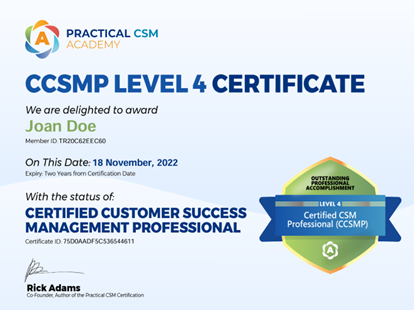
Sample Evidence Page:
https://academy.practicalcsm.com/evidence-page/?bg=78533&eid=23476&uid=10
Exam A
Exam Part A is a 60-minute exam comprising 50 questions that are similar in format to the questions you have been asked within the end of module tests. This exam tests your overall knowledge across all ten modules of the CCSMP syllabus. The pass rate for Exam A is 75%.
Exam B
Exam Part B is a 40-minute exam comprising just 8 questions. These questions are much lengthier in their nature and incorporate a real-world scenario for you to consider. You are then asked to select the answer that most closely matches the stated requirement for the specific scenario. This exam tests your ability to apply your knowledge in real world situations and again covers all ten modules of the CCSMP syllabus. The pass rate for Exam B is 62%.
Exam Retakes
- If you do not pass, wait 2 days before 2nd
- If needed again, wait 2 more days and take the 3rd
- After three failed attempts of the same exam, wait 14 days before trying again.
- Each retake presents a different set of questions.
Level 5 – Continuing Professional Development & Recertification
Level 5 Overview
CCSMP Level 5: Strategic Growth & CPD
Outcome: Maintaining an elite edge in an evolving industry.
Level 5 shifts from “certification” to “Continuous Professional Development” (CPD). It is designed for leaders who recognize that Customer Success is a fast-moving discipline requiring ongoing learning in areas like Scaling CS, Leadership Skills, and Tech Startup Growth.
- CPD Dashboard: A structured interface to track 40 hours of annual learning, ensuring the CSM remains a peer-level consultant rather than a static practitioner.
- Available: CCSMP Full, CPD Membership
Level 5 Sample Certificate
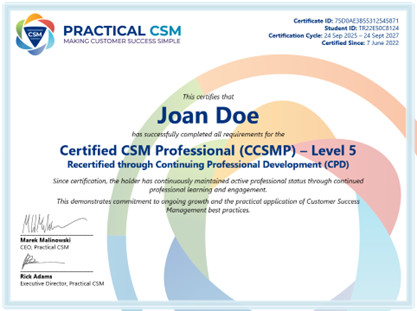
Note: We are testing and developing CPD Membership. All Level 5 certificates are issued by our training specialists. Self-service and evidence page coming Q4 2026
Component 1: CPD Paths
CPD Paths are curated learning tracks that bundle related CPD items into a structured sequence. They help you build skills in a focused way, follow a clear theme, and track progress as you work through each path at your own pace.
Scaling Customer Success
Category: Leadership Skills for CS
Description:
The “Scaling Customer Success” CPD Path is a comprehensive four-part training session designed to equip professionals with the knowledge and skills necessary to effectively scale customer success within their organizations. This program focuses on two key aspects: cost-effective methods to extend customer success services to a larger customer base and intelligent segmentation strategies based on customer-centric criteria.
Contents: Articles (2), Videos (4), TOTAL (6)
Duration: 1h 56m
CS Leadership Skills
Category: Leadership Skills for CS
Description:
Leading Customer Success is never easy and requires Customer Success Leaders to continually develop their skills. Luckily Practical CSM is offering a Customer Success Leadership webinar series designed to sharpen executives’ Customer Success awareness, performance mindsets, negotiation techniques, creativity and problem-solving ability.
This series of eight webinars covers an extensive range of leadership topics, such as Executive Awareness, Performance Mindsets, Radical Creativity, Solving Real Problems and Effective Reporting. These webinars will give Customer Success Leaders the insights they need to better understand their clients’ needs; allowing them to provide more value and drive greater business results in the long term.
Contents: Videos (6), TOTAL (6)
Duration: 6h 4m
Developing, Implementing & Managing a Modern CS Service
Category: Leadership Skills for CS
Description:
Developing, Implementing and Managing a Modern CS Service is an 11-part webinar path with Rick Adams and Peter Armaly, focused on building a practical, end-to-end Customer Success service. It walks through modern CS challenges, research and gap analysis, customer segmentation, role design and automation, frameworks, systems and processes, enablement (training, coaching), and then measurement, reporting, and cross-functional collaboration to keep the service improving over time.
Contents: Videos (11), TOTAL (11)
Duration: 11h 7m
CSM Power Skills
Category: Skills Training
Description:
Customer Success Management is one of those roles that sits in the middle of many existing duties. It takes aspects of each of them (and more) and re-utilizes those aspects for its own purpose – that of assisting the customer to attain its desired or required outcomes from the products and services it has purchased from us. To be a good Customer Success Manager, therefore, requires an in-depth understanding of many different skills; from data analysis through to stakeholder management and everything in-between.
Contents: Videos (10), TOTAL (10)
Duration: 10h 20m
Driving Tech Startup Growth Through CS
Category: Startups
Description:
Driving Tech Startup Growth Through CS is a focused CPD path designed for early-stage SaaS and B2B tech companies that want to use Customer Success as a growth lever, not just a support function. Created in partnership with the OneEleven accelerator in Toronto, this miniseries combines short expert interviews with practical companion PDFs, giving both insight and structured takeaways.
Across 14 items, the path explores what to consider when introducing Customer Success in a startup environment, how CS reduces churn and increases renewals, and how it directly supports expansion revenue. It includes conversations with startup leaders and CS practitioners, alongside concise downloadable summaries that help translate ideas into action.
This path is ideal for founders, startup CSMs, and post-seed teams who need clarity on where CS fits, what training is required, and how to position Customer Success as a strategic driver of sustainable growth.
Contents: Videos (7), Downloads (7), TOTAL (14)
Duration: 2h 23m
Becoming the Best Possible CSM
Category: Skills Training
Description:
The basics are the foundations, and now that you have built your own foundation, it is time to grow to the next stage and become the best possible CSM that you can be.
In the first section of the Essential Skills for CSMs program, you were introduced to the most essential personal skills that are necessary for a Customer Success Manager to succeed in their role. But now you have learned these skills, how can you put them into practice, and start generating value for your customers and (ultimately) for your own company? Becoming the Best Possible CSM discusses how to utilize those skills to drive value – the best way.
Contents: Videos (12), TOTAL (12)
Duration: 3h 16m
Basic Skills for CSMs
Category: Skills Training
Description:
Our Basic Skills for CSMs program covers each of the fundamental skill areas that a successful Customer Success Manager will draw upon to do their job well. Containing a wide range of skills from problem identification to dealing with difficulties, the Basic Skills for CSMs program is a comprehensive range of courses, teaching you the basics of each essential skill, in order to help you to achieve value for your customers.
Begin your journey to becoming an effective CSM that knows how to drive growth, reduce churn, and generate rapid value for customers and for your own company!
Contents: Videos (24), TOTAL (24)
Duration: 6h 44m
CX Field Manual
Category: Customer Experience
Description:
CX Field Manual is a structured 8-part video series focused on building and strengthening a Customer Experience Management program that delivers measurable business value.
Using a clear, field-manual style structure, the series walks through the full CX journey – from defining the mission and leadership mindset, to organizing the CX function, assessing current performance, gathering customer intelligence, and developing practical action plans. It then moves into execution topics such as inspection, alignment at senior level, and maintaining situational awareness across the organization.
This path is designed for CX leaders, senior managers, and Customer Success professionals who want a disciplined, strategic approach to Customer Experience – one that connects customer insight, organizational structure, and leadership alignment into a coherent, actionable program.
Contents: Videos (8), TOTAL (8)
Duration: 6h 34m
Other CPD Paths
- Practical Customer Success Management Podcasts (88 CPD Items / 47h 49m)
- Customer Success Bite-size Learning (58 CPD Items / 5h 56m)
- Preparing for a New Customer Engagement (7 CPD Items / 2h 22m)
- Customer Success Book Club (18 CPD Items / 8h 42m)
- Customer Success Thought Leaders Interviews (19 CPD Items / 17h 34m)
- Customer Success in the Digital Era (3 CPD Items / 3h)
- Practical CSM Framework (5h 54m)
- Women Leaders in Customer Success (12 CPD Items / 6h 32m)
- Customer Success Leadership Conversations (8 CPD Items / 6h 41m)
- CS Debates (4 CPD Items / 3h 6m)
Component 2: Content Library
The Content Library gives you access to 1000+ CPD items and over 300 hours of on demand learning materials. It is designed for flexible, self-directed development.
You can quickly find relevant content whether you are addressing a specific challenge, deepening expertise in a topic, or staying current with trends in Customer Success and Customer Experience.
Key features:
- 1000+ individual CPD items
- 300+ hours of video and learning content
- Sort by category
- Search by keyword
- Browse by format type – videos, articles, audio, downloads, tools
- Add individual completed items directly to your CPD record
Component 3: Live Events Calendar
The Live Event Calendar gives you ongoing access to fresh learning through live sessions, partner events, and Practical CSM hosted events. It is where you can join scheduled training, informal conversations with industry experts, and structured panel discussions.
You can browse upcoming events by heading, register for anything that is relevant, and attend as many sessions as you want. The calendar is also shaped by student input. If there is a topic you want covered or a guest you would like to see featured, you can submit suggestions and the team will review them for future sessions.
Key features:
- Mix of partner events and Practical CSM hosted events
- Live training sessions, expert conversations, and panel discussions
- Always updated with new events and topics
- Browse events by headings and register in a few clicks
- No limit on how many events you can register for
- Student suggestions welcomed for future topics and guests
Component 4: Suggest a New CPD Training Topic
The Suggest a Topic form lets students influence what gets created next in the CPD Library. Since the library is always expanding, this is a simple way to request new topics, skills, or challenges you want cover.
You can propose ideas for new Mini Courses, downloadable resources, or deep dive webinars. Every suggestion is reviewed and helps guide the CPD roadmap.
Key features:
- Direct channel to suggest future CPD topics
- Request content based on real skills and challenges
- Ideas can be for Mini Courses, guides, templates, or webinars
- Helps shape the evolving CPD Library and roadmap
Component 5: CPD Self Certification
The CPD Self Certification Form lets you log external learning toward your annual CPD total. If you complete CPD outside the Practical CSM Library, you can submit the details here and have the hours added to your CPD record.
You provide basic info about what you completed (for example a book), who provided it, the duration, and the completion date. You also confirm that you completed the learning and agree to keep evidence (like a receipt or screenshot) for up to 12 months in case of an audit.
Key fields and requirements:
- Name and email
- Content type (example: book)
- Title or description and publisher/provider
- Duration (hours 0-100, minutes 0-60)
- Date completed
- Consent confirmation to add hours and retain evidence for 12 months for audit purposes
Component 6: Reporting & Recertification
The Reporting and Recertification area is your dedicated CPD dashboard. It brings together your learning progress, detailed activity history, time tracking, and recertification status in one structured view.
It is designed to help you manage Continuing Professional Development as an ongoing professional habit, while also providing clear and auditable evidence of your development over time.
If you hold CCSMP Level 4, this is also where you monitor your annual recertification requirement – a minimum of 40 hours of CPD every 12 months from your certification anniversary date.
CPD Paths Progress
This section shows every CPD Path you are enrolled in, including:
- Path category
- Start date
- Progress by number of steps completed
- Percentage completion
- Status (Not Started, In Progress, Completed)
- Total path duration
- Direct launch button to continue learning
You can quickly see where you are, what remains, and jump straight back into the next item.
CPD Activity History
This is your full CPD learning log across the entire library and other recorded CPD sources.
For each completed item, you can see:
- Completion date
- Item title
- Asset type (video, article, workbook, etc.)
- Activity type
- Duration
- Launch button to revisit the item
This creates a detailed and time-stamped record of your professional development activity.
Recertification
If you have achieved CCSMP Level 4, this section displays:
- Your Level 4 achievement date
- Your recertification anniversary date
- Your certification expiry date
- Total CPD hours completed toward recertification
- Remaining CPD hours required
You can clearly monitor your progress toward maintaining your Level 4 status and ensure you stay compliant with the 40-hour annual requirement.
CPD Time
This section allows you to filter CPD activity by specific periods – year, month, or custom date range.
For the selected period, you can see time spent across:
- CPD Library learning
- Live learning sessions
- Workshops
- CPD Paths
- External CPD
- Overall total CPD time
This provides both high-level summaries and detailed breakdowns, giving you full visibility over your development investment.
Let’s talk about your Customer Success goals
If the program details on this page raised questions or made you reflect on your own situation, you’re not alone. Some people are exploring how to structure their own career path. Others are reviewing certification options for their team.
At this stage, most reach out to clarify fit, understand progression options, or sense-check whether the program aligns with their goals.
Use the form below to share a bit about yourself or your team, and what you’re looking to achieve. We will respond with relevant guidance and context, not a sales pitch.