
Nov9Mon 9 Nov 2026
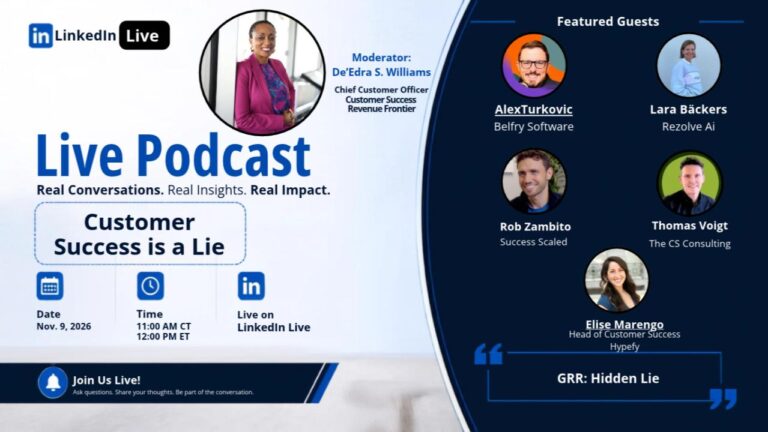
Customer Success Is A Lie: GRR – Hidden Lie
Partner: De'Edra S. Williams VirtualWebinar
All day
Thu 5 Nov 2026
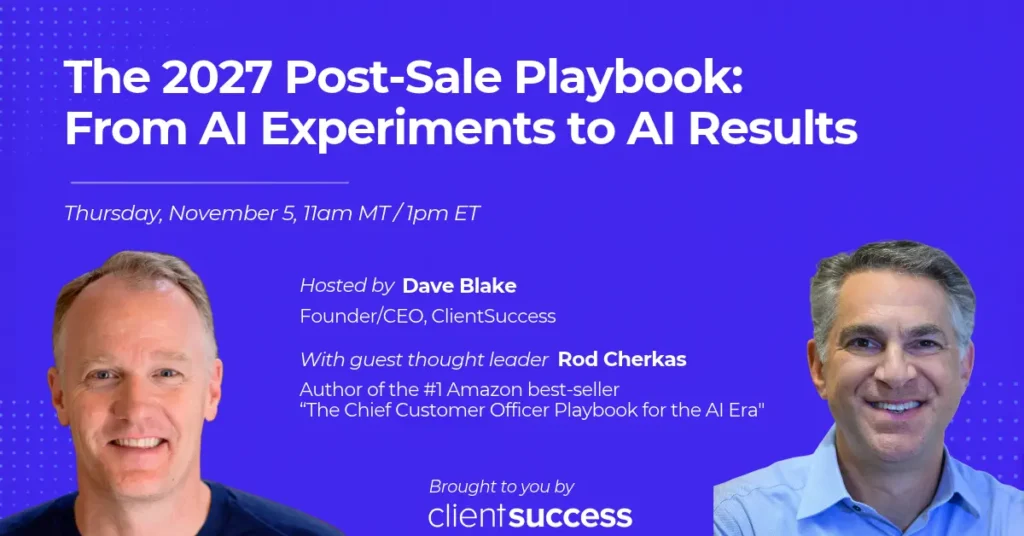
Your playbook was written before AI changed what is possible. This session is about what that means for the 2027 plan you are defining right now, and how to get it onto one page.
There is a meeting most post-sale leaders have now had at least once. An executive asks what AI has done for the business, and the answer that comes back is a list of tools. Names of vendors, counts of pilots, a note about how much the team likes the new summaries. It is not a bad answer. It is just not an answer to the question that was asked, and everyone in the room can hear the difference.
Rod Cherkas surveyed nearly 200 post-sale leaders for his new book. Roughly 70% said their teams were piloting or experimenting with AI. Only 7% could measure whether any of it was working.
The gap between those two numbers is the whole subject of this session. It is not a tooling gap. Every team in that survey has access to broadly the same models, the same vendors, and the same budget arguments. What separates the 7% from the 70% is that somebody decided, in advance, which business number the work was supposed to move and who owned it.
Everyone has the same tools, so the difference is leadership.
An AI Strategy on a Page is a single-page summary of a post-sale team’s AI plan: which area of AI impact the team owns, which initiatives are funded against it, which business number each one is expected to move, and what is being retired from the existing playbook to make room for it.
The one-page constraint is doing real work. A plan that takes ten slides to explain has usually not been decided yet, it has been collected. Forcing the strategy onto a single page is what surfaces the two questions teams skip: what is this supposed to change, and what are we stopping in order to do it.
Most post-sale playbooks in use right now were designed for a set of constraints that no longer hold. They assume a certain cost per account touched, a certain floor on how long a QBR takes to prepare, a certain ratio of accounts to CSMs. Those assumptions were correct when they were written. Several of them are not correct any more.
That does not mean the playbook is wrong. Most of it is still load-bearing, and the teams that throw it out wholesale tend to spend 2027 rebuilding things that already worked. The useful exercise is narrower and harder: go through it deliberately and sort it. What stays as written. What stays but changes shape. What should have been retired already and is being kept alive by habit.
Rod and Dave will get specific about where those lines fall, and about the difference between an AI initiative that will move a number and one that will only make existing work faster. Both are worth doing. Only one of them survives the meeting where an executive asks what changed.
This session is for Customer Success and post-sale leaders who are deciding where to invest time and resources in 2027, and who expect to be asked to defend those choices. VPs and Directors of Customer Success, Chief Customer Officers, and the leaders who own Professional Services and Support organizations.
Rod Cherkas is the CEO of HelloCCO, a strategy consulting firm that works with companies on their customer-facing functions, and Chair of the AI in Post-Sale Council. He spent his earlier career as a post-sale executive at Intuit, RingCentral, Marketo, and Gainsight. His third book, The Chief Customer Officer Playbook for the AI Era, was released in September 2026 and reached number one on Amazon. Dave Blake, Founder and CEO of ClientSuccess, hosts and moderates.
All day
Tell us about it and we will list it alongside our own sessions.
Submit your eventFrom the book published by Taylor & Francis. Two versions; pick the one that fits you.
Pick your version, we email the PDF.