

Practical Customer Success Management: Chapter One, An Overview of the Customer Success Manager’s Role
The first chapter of the book Practical Customer Success Management (Taylor & Francis, 2018). It defines customer success, outcomes and KPIs, explains why CSM is growing and sets out the 14 tenets of Customer Success Management.
The short version
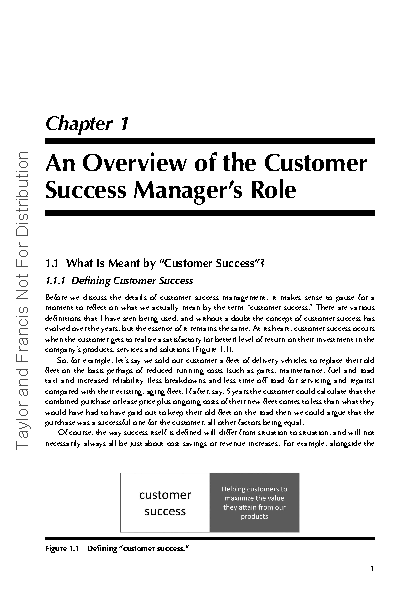
TLDRCustomer success happens when the customer realizes a satisfactory return on their investment in your products and services. The chapter explains how CSMs help make that happen, where they fit among customer-facing teams, and the 14 tenets a CSM should work by.
7 topics in 16 pages
- Defining customer success
- Outcomes and KPIs, with a worked example
- The customer as a business partner
- Why as-a-service buying makes CSM more important
- Core CS activities and additional value
- Where CSMs fit with marketing, sales, support and services
- The 14 tenets of Customer Success Management
5 ideas you can use this week
Focus on product value
The CSM's primary role is to make customers successful through the products and services they bought.
Define outcomes properly
A well defined outcome has a quality, a quantity and a deadline, and KPIs track progress towards it.
Understand the shift in risk
As-a-service contracts move risk from customer to vendor, so vendors need customers to see value and renew.
Know the core activities
Onboarding, adoption, ongoing value creation, measurement and reporting, and adapting and fine-tuning.
Work by the 14 tenets
They describe the CSM as value creator, subject matter expert, adviser, educator, communicator, planner and problem solver.
Questions
Get certified on the Framework
The CCSMP certification (Certified CSM Professional) is built on the Practical CSM Framework: five levels in three packages, for individuals and teams.